About Grand Canyon West And How to Get There from Vegas
 For a different look at the canyon, take a trip to Grand Canyon West. It sits in Arizona, it is owned by the Hualapai tribe, and it is home to the Skywalk — a glass walkway that puts you out over the canyon floor with the Colorado River 4,000 feet below. It is also the closest piece of the Grand Canyon to Las Vegas, which is why most people reading this end up going there.
How Far Is the West Rim from Las Vegas?
About 120 miles, and roughly two and a half hours behind the wheel. That is the honest number, door to door, and it is the single most useful thing to know before you plan the day. It is a comfortable morning drive — nothing like the run out to the South Rim, which is closer to five hours each way and eats an entire day.
The drive takes you out of Las Vegas on US-93 south across the Hoover Dam bypass bridge, then east into Arizona and onto the Pierce Ferry Road turnoff, and finally onto Diamond Bar Road for the last 14 miles into Grand Canyon West.
Is Diamond Bar Road Paved?
Yes. Diamond Bar Road is paved now, the whole way in.
This trips people up, because for years it was not, and half the advice still floating around online is out of date. It used to be a graded dirt road that rattled the fillings out of a rental car and put people off driving themselves entirely. That is no longer the situation, and you do not need a four-wheel drive or a high-clearance vehicle to get there.
Two things have not changed. RVs are still not allowed on Diamond Bar Road. And once you arrive you park at the entrance and welcome center — you do not drive your own car around the rim. A park-and-ride coach runs between the welcome center and the viewpoints, and it is worth calling ahead to reserve a seat. There is a fee for the coach, and a separate one for the Skywalk itself.
Watch the Clock: Arizona Time vs Las Vegas Time
This one catches people out every year, and it is worth two minutes of your attention if you are holding a timed ticket.
Arizona does not observe Daylight Saving Time, and neither do the Hualapai at Grand Canyon West. Nevada does. So for part of the year the West Rim is an hour ahead of Las Vegas, and for the rest of the year the two are the same. Which means the clock on your phone may or may not agree with the clock at the welcome center, depending on when you visit and whether your phone has worked out where it is.
Get it wrong and you miss a tour you have already paid for. I have written about this in more detail in Check Your Watches: The Arizona Time Zone Plays Havoc With Tours.
Bus, Helicopter or Airplane?
Las Vegas is the starting point for every West Rim tour, and nearly all of them are day trips because it is such a short hop. How you get there comes down to time, budget, and the kind of day you want.
By bus is the most economical, and you do not have to drive. It is a long day but a relaxed one, and the good packages bundle the Skywalk ticket so you are not sorting that out at the gate. See Las Vegas Grand Canyon bus tours.
By helicopter is the most thrilling, and it is the only way to land at the bottom of the canyon. Roughly 25 minutes in the air instead of two and a half hours in a car.
By airplane is best if your time is tight — see Grand Canyon airplane tours from Las Vegas.
Driving yourself gives you the most freedom and the fewest inclusions. You set your own pace, but you are buying the coach ticket and the Skywalk ticket at the gate, and you are driving home tired.
Use these links to jumpstart your West Rim adventure:
The Grand Canyon Skywalk
The Skywalk opened for business in 2007. David Jin, a tourism entrepreneur, came up with the idea while on a trip to Grand Canyon West. He eventually got funding and partnered with the Hualapai tribe to build the glass bridge, which was designed by esteemed architect Mark Ross Johnson. The horseshoe-shaped walkway is 65-feet wide and extends some 70 feet over the ledge and 4,000 feet above the canyon's base.
Glass-bottomed, this attraction might prove frightful to those who have a fear of heights, but is deemed perfectly safe by safety experts and building inspectors. The sides feature glass-wall railings. Further, the bridge was designed to withstand substantial windstorms and earthquakes. Technically, it can hold 800 people but only 120 visitors are allowed on it at one time. It's reported that the bridge cost $30 million to build!
You cannot take your phone or your camera onto the Skywalk. Not a compromise, not a maybe — the Hualapai run metal detectors as serious as the ones at the airport, and nothing goes across the line. Leave it in the locker, go with it, and buy the photo on the way out if you want a picture. I have written more about what the experience is actually like in Skywalk Expectations.
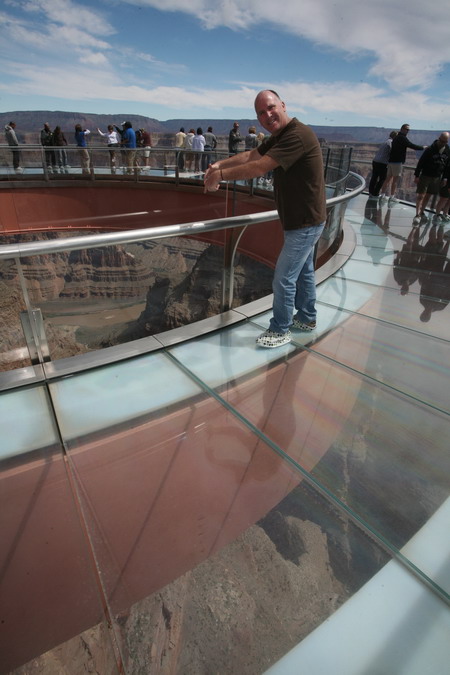
What Else Is Out There
Grand Canyon West is outside the boundaries of Grand Canyon National Park. It's part of the one million acres owned by the Hualapai tribe. The Skywalk marks the start of larger development, which at the moment includes a visitor's lounge, gift shops and snack bars. Future plans for this 100-mile stretch along the West Rim include resort hotels, a golf course, a restaurant row and a cable-car system from the rim to the Colorado River. Some members of the 2,000-member Hualapai tribe oppose development because it affects sacred ground while others embrace change and see it as a source of much-needed jobs and income.
Paul Bunyan And the Grand Canyon?
Per American folklore, the Grand Canyon was created when lumberjack Paul Bunyan dragged his giant axe on the ground. Natural history, on the other hand, states that the canyon was formed some 80 million years when the two of Earth's plates, the North American and the Pacific, collided and formed the Rocky Mountains. The Colorado River also sprung from the geological event, and, seeking an outlet, etched its way through this formation and created the Grand Canyon.
Make It a Grand Day!